 BRIDGE1

Reference Mac: Apple M1 Max · 32-core GPU · 64 GB. Decode is engine-reported tokens per second; other Macs are not measured.
OptiQ 4-bit · default for coding
Ornith 1.5 35B-A3B
- Engine
- MLX
- Download
- 23.1 GB
- Admitted window
- 229,376 tokens
- Memory: measured or estimated
- 54.9 GB · measured
- Short decode
- 81.2 tok/sconditions not recorded
- Decode at depth
- not measured
- SWE-bench Verified (base weights)
- 79.0 creatorconditions not recorded
- Catalog date
- 2026-10-09
GGUF Q4_K_M · editor's choice
Ornith 1.5 35B-A3B
- Engine
- GGUF / llama.cpp
- Download
- 21.7 GB
- Admitted window
- 262,144 tokens
- Memory: measured or estimated
- 29.0 GB · estimated
- Short decode
- 61.5–70.1 tok/sconditions not recorded
- Decode at depth
- not measured
- SWE-bench Verified (base weights)
- 79.0 creatorconditions not recorded
- Catalog date
- 2026-10-09
Ornith 1.5 35B-A3B is published by ornith-ai. This separate section covers the GGUF Q4_K_M profile through llama.cpp. Its catalog download is 21.7 GB, with a 262,144-token admitted context window and 29.0 GB estimated running memory on the reference Apple M1 Max with a 32-core GPU and 64 GB unified memory. The memory figure is an estimate, not a measured full-window peak or a minimum Mac requirement.
Vision is marked Yes for this profile, and tool calls are supported. That capability does not establish completion of a coding task through every client. No exact-profile coding-task result is established here for GGUF Q4_K_M; do not transfer the small-repository result elsewhere on this page to it. Try a short explanation of one function, then a bounded edit with a test you can inspect. This is a suggested task, not a reported pass.
The catalog window describes the reference Mac. Check the window offered on your own Mac, leaving room for macOS, your editor and other apps. A native context ceiling does not prove that a conversation of that length fits. Full-window peak memory, decode at depth and end-to-end task speed for this profile are not measured here. Short decode lacks recorded conditions, so it supplies no timing promise.
Select GGUF Q4_K_M before following the client setup below. On macOS, the launchers are bridge1 launch claude, bridge1 launch codex, bridge1 launch opencode and bridge1 launch pi; model readiness and installed client versions still apply. Claude Desktop and Hermes Agent use manual setup. Follow each linked guide, check the chosen model, request one ordinary reply, and separately inspect any proposed edit. Hermes Agent and Pi.dev retain one-turn smoke-test scope.
Choose a different catalog model if this profile does not leave room for your work, or if your task depends on a verified long sequence of edits. The estimated fit alone does not answer that task-quality question. No speed or quality comparison between profiles follows from this section.
The catalog explicitly marks the MLX OptiQ 4-bit profile as the default for coding. As of 2026-09-26, Bridge1’s published evaluation records 40 passes out of 40 through Claude Code on small Python repositories with hidden tests.
That result answers a narrow question: could the model complete those tasks through that client? It does not establish the same completion rate on a large repository, in OpenCode, or for both quantizations separately. Start with a small change you can test in your own project.
Choose something else when your priority is a dense model with a different context tradeoff, or when neither Ornith profile leaves enough room for your other apps. Qwen3.8 offers a useful next comparison; the catalog also has smaller models.
Select MLX OptiQ 4-bit for the catalog’s coding default. Its download is 23.1 GB, its admitted window is 229,376 tokens, and its measured peak at that window is 54.9 GB on the reference Apple M1 Max with a 32-core GPU and 64 GB of unified memory.
The GGUF Q4_K_M profile runs through llama.cpp: 21.7 GB on disk, a 262,144-token admitted window and 29.0 GB estimated memory. Consider it when that estimate better fits your budget, but keep the estimate distinct from a measured peak.
Both rows come from the catalog dated 2026-10-09. A smaller estimated total does not establish equal task quality between the two files. Leave memory for macOS, your editor and the conversation, then check the window Bridge1 admits on your own Mac.
Swipe to see the whole row
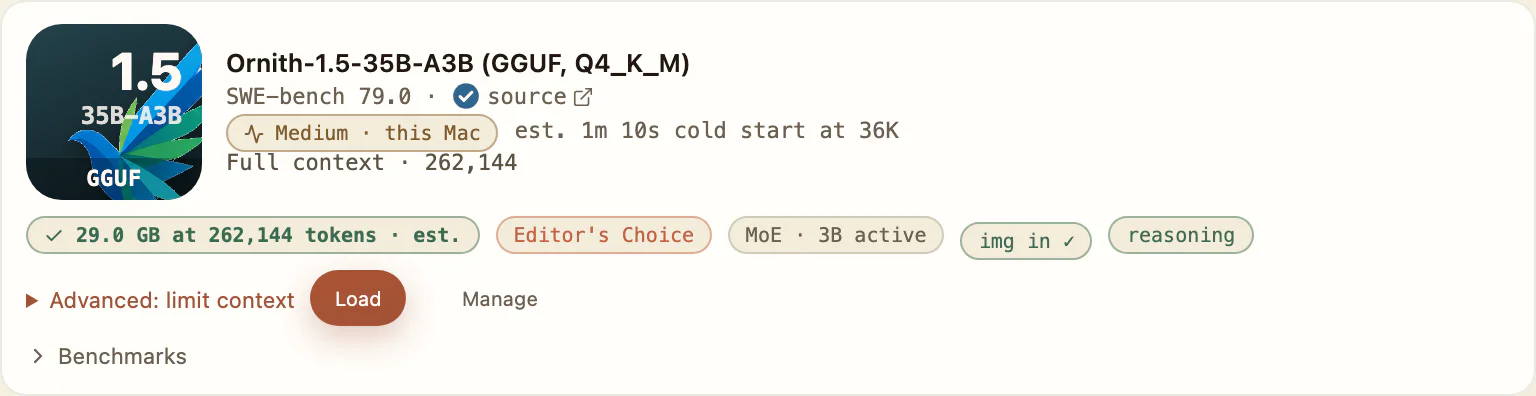
Check the GGUF profile name and the estimated label rather than treating it as the MLX result.
Common scale: 0–60 GB
Ornith 1.5 35B-A3B
OptiQ 4-bit · default for coding · MLX
- Download size
- 23.1 GB
- Measured peak at this window
- 54.9 GB
- Admitted window
- 229,376 tokens
Catalog date:
Ornith 1.5 35B-A3B
GGUF Q4_K_M · editor's choice · GGUF / llama.cpp
- Download size
- 21.7 GB
- Catalog memory estimate
- 29.0 GB estimated
- Measured peak at this window
- not measured
- Admitted window
- 262,144 tokens
Catalog date:
MLX: 23.1 GB download, 229,376 tokens, 54.9 GB measured peak. GGUF: 21.7 GB download, 262,144 tokens, 29.0 GB estimated memory.
The short-decode cells retain their recorded rates and say that conditions were not recorded. Depth decode is not measured for either profile. Those cells cannot tell you how long a full coding request will take, especially when the client must read a long chat first.
Use the published coding evaluation for task scope and the memory labels for fit. Neither is a cold-start measurement. The screenshot labels belong to the app; read the measured memory peak in the chart separately.
Use the admitted window and the evidence for this profile when deciding what fits your work.
On macOS, bridge1 launch starts Claude Code, Codex, OpenCode or Pi with Bridge1, subject to the installed client version, model availability and loading settings; the manual steps still work. Choose Ornith in Bridge1, then open Gateway and select OpenCode. Route1 follows your selection. The connection values below are a starting point; copy Gateway’s full provider entry for the chosen profile before opening your project.
Keep the generated attachment and modalities fields when present. OpenCode cannot see token usage in Bridge1 replies yet, so it may not compact a long session on its own. The client guides below give the other connection paths.
// Add this "bridge1" entry to the "provider" object in ~/.config/opencode/opencode.jsonc,
// and set "model" to "bridge1/route1"
"bridge1": {
  "npm": "@ai-sdk/openai-compatible",
  "name": "Bridge1",
  "options": {
    "baseURL": "http://127.0.0.1:54321/v1",
    "apiKey": "YOUR-GATEWAY-KEY"
  },
  "models": {
    "route1": {
      "name": "route1",
      "attachment": true,
      "modalities": {
        "input": [
          "text",
          "image"
        ],
        "output": [
          "text"
        ]
      },
      "limit": {
        "context": 262144,
        "output": 32768
      }
    },
    "mtp-qwen3.6-35b-a3b-gguf": {
      "name": "mtp-qwen3.6-35b-a3b-gguf",
      "attachment": true,
      "modalities": {
        "input": [
          "text",
          "image"
        ],
        "output": [
          "text"
        ]
      },
      "limit": {
        "context": 262144,
        "output": 32768
      }
    }
  }
}These OpenCode connection values use a placeholder key. Merge the complete provider entry from Gateway into your OpenCode configuration; keep its generated model and context fields.
The Hugging Face pages declare different licences: Ornith’s original model declares MIT, its official GGUF page declares MIT, and the MLX Community OptiQ page declares Apache-2.0. The three links below identify those declarations side by side, accessed 2026-10-19.
These are declarations on the linked pages. A matching model name does not establish the exact revision used by the catalog, and the current conversion page’s size need not match the catalog download.
OpenCode setup
- Select this model in Bridge1. Merge Gateway’s generated bridge1 provider entry into your OpenCode configuration and select bridge1/route1 or its supplied plain model id.
- Keep attachment and modalities fields when supplied. Check compaction and prompt-reread limits in the OpenCode guide before a long chat.
Pi.dev setup
- Copy Gateway’s custom-provider JSON for the chosen model and verify the model selection before use.
- Keep input, contextWindow and maxTokens when supplied. Early support covers one short smoke-test turn; follow the Pi.dev guide for the current setup.
Codex setup
- Save Gateway’s generated provider configuration with wire_api set to responses and a base URL ending in /v1.
- Use route1 or the plain model id supplied by Gateway. For Codex Desktop, use the same configuration, then quit and reopen the app.
Hermes Agent setup
- Add a custom endpoint with Gateway’s URL, your non-blank key and route1 or the supplied plain model id. Use Test, then Save.
- Preserve generated vision and context values, including supports_vision when supplied. Early support covers a single smoke-test turn.
Claude Code setup
- Copy the Claude Code launch command from Gateway and run it in your project folder with your own gateway key.
- Keep claude-route1, timeout values and any extra context setting generated for the selected window. Use the guide to review Auto mode limits.
Claude Desktop setup
- Download config.json from Gateway, enable Developer Mode and open Configure Third-Party Inference; choose New → Import in the configurations switcher and select the file.
- Select the Bridge1 configuration, restart Claude Desktop and use Test connection. Review Code tab timeouts before a long prompt.